Hey everyone!
I just wanted to give anyone reading a heads up that August is going to be absolutely crazy for me. I'm about to head to Lollapalooza, followed by a visit to my sister in IL, then my wedding and the honeymoon (to Seattle and Vancouver). I have a few posts I've been planning but I'm not sure when I'll get around to posting them. Hopefully I'll find some time during this crazy month, but if not, I'll see you in September!
Thursday, August 5, 2010

Friday, July 23, 2010
Foodie Book Club: The Butcher and the Vegetarian
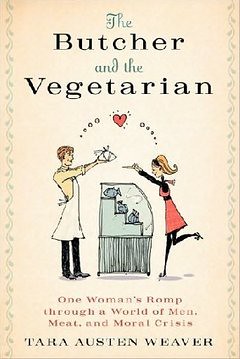
The Butcher and the Vegetarian by Tara Austen Weaver was the June selection for the Foodie Book Club (Yes, June. Excuse the lateness.)
I absolutely loved this book. Weaver, a vegetarian, explores the world of meat after struggling with health problems and a few doctors suggesting she tries to eat more meat. She details her journey exploring questions like should we eat meat and if so, from where? Commercial feedlots? Sustainable, local, organic farms? How can you tell if your meat is produced 'right'? Will meat really make her feel better?
I have personally thought about these questions over and over again. I've read several books on the subject, but coming up with an answer is difficult. I am not and have never been a vegetarian, but when I was a kid, I'd almost always pass on meat, unless it was chicken fingers, bacon, or a cheeseburger. Meat on the bone? Roasted pork loin? Turkey on Thanksgiving? No, thank you. It grossed me out. I never even ate steak until I was eighteen.
Do I think it is wrong to eat meat? The answer is not as simple as yes or no. I do believe we are omnivores, with bodies meant to eat both meat and plants. However, I think eating the majority of meat that is produced in this country is wrong and the amounts in which we eat it are even worse. I have a huge problem with CAFOs and the pollution they produce, causing both the animals and humans around them to get sick. I think its wrong to keep tens of thousands of chickens crammed in hen house where each animal can barely move around. I think its wrong that we have bred animals that are so large they cannot walk more than a few steps or even reproduce naturally. But pastured cows and chickens raised on local farms? That is something I can support (as with George the chicken from my last post).
Critics say that there is no way to produce enough meat to feed the country, let alone the world, on a pastured based system. And they are probably right. But guess what? People do not need to eat meat at every meal, let alone every day. For both environmental and health reasons, this country would do a lot better for itself if it incorporated more plants into its diet. You may notice from the recipes I post here are almost all vegetarian and that is how I usually eat. I'm not perfect, but I try not eat meat at restaurants unless they are restaurants I trust. Luckily Minneapolis has plenty of restaurants with local, organic, and sustainable values (my favorites include Restaurant Alma, Common Roots Cafe, Lucia's, Brasa, and the Birchwood Cafe). If I want to prepare meat at home, I buy it from the Farmers Market or a natural foods co-op. Yes, it is more expensive to buy meat that way, but I buy it so rarely I am willing to pay the extra price. The meat that comes from a commercial feedlot is not as cheap as the price tag might indicate, its costs are externalized to subsidies, health bills, etc. There is really no such thing as cheap meat.
But anyway, I'll stop with my food beliefs and go back to the book. It was a great read, I finished it over the course of two days. It was great to read along as Weaver researched and discussed all the issues surrounding meat that I have thought of myself. There were times I cringed (like the story of the cow from a commercial feedlot that wouldn't compost...gross!) . I also related to her discussion of how to deal with eating at other people's houses. This is something I've struggled with as well. I can't really say that I'm a vegetarian, but how to explain to someone that "Yes, I eat meat, but only some meat and that meat you are serving just isn't good enough for me" and not sound like a uppity bitch? You just can't.
At the end of the book, Weaver commits herself to two-week long experiments: one week of eating meat 3 times a day and one week going totally raw. The meat week leaves her feeling gross and dreading meals. She decided to go raw for a week as a sort of detox and the first few days she says she was always hungry, but the food wasn't bad at all...and then a few days later? She starts to feel better. Energized. She realizes that for the first time in years, she isn't exhausted all the time. It's the raw diet that ends up working for her. I found myself almost laughing at the end, reading the whole book about meat to leave with her becoming a semi-raw foodist. She says it probably isn't for everybody, but that is what works for her and she finally figured it out.
The one thing I didn't really like is the fact that the title and the cover illustration led me to believe there was a love story involved, that she would eventually marry a butcher or something like that. Every time she talked about some meat loving man (like Biggles who writes a meat blog), I kept waiting for the romance, but it never came. I'm not saying there needed to be a romance, but I found that to be a little misleading and distracting. Also, the book jacket mentions a butcher daring her to eat her way through the meat counter, so I also was expecting her to try everything at the butcher and go through it piece by piece. I did enjoy the book, but these bits were a little misleading and not everyone who takes a quick glance at it might end up satisfied.
Titles and false expectations aside, the book inspired me to get in the kitchen twice. The first time I made flank steak with the chimichurri sauce she mentions so often. I would have posted that recipe here, but I almost burned the house down when I made it, not realizing there were some plastic pieces on my new roasting pan (why? I have no idea, but I didn't see them and remove them before broiling the steak the house filled with smoke). But it was delicious. After finishing the book, I was intrigued by the raw kale salad she mentions at the end. I have heard that kale can be eaten raw and is quite good if you massage it with salt until it wilts, but I never mustered up the courage to do so (as Weaver says, it sounds too "aggressively healthy" to be good). I was surprised how good it ended up being. I know it sounds scary, but try it! It's actually quite delicious.
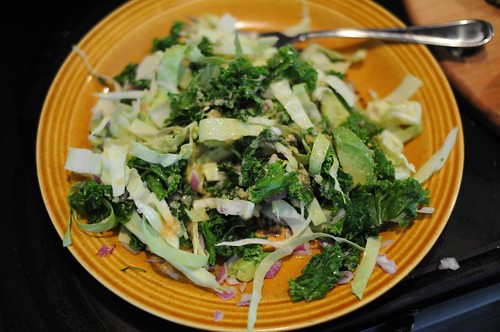
Raw Kale Salad
From Tara Austen Weaver's site
Dressing:
1 tbsp olive oil
1 tbsp flax oil (I don't have any so I used walnut. I'm sure you could also double the olive oil instead.)
1 tbsp light miso
1 tsp onion powder
1 tsp mustard powder
1 clove garlic, crushed or chopped
cayenne pepper to taste
Whisk all the ingredients together until combined.
Salad:
About 3 leaves kale, with stems removed and cut into ribbons
1 cup cabbage, shredded
1/2 avocado
sea salt
1 tbsp red onion, chopped
1 tbsp jalopeno, chopped (optional)
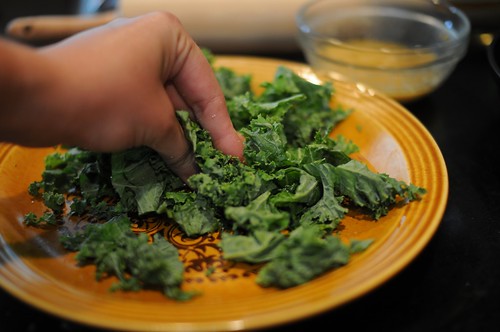
Sprinkle the sea salt onto the kale and massage in until slightly wilted.
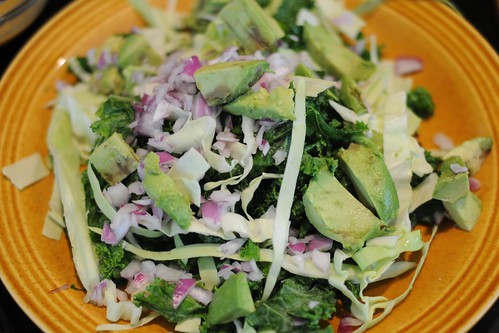
Toss with the other ingredients, add dressing, and eat!

Sunday, July 18, 2010
Zuni Cafe Roast Chicken (Part One)
(Note: Vegetarians and Vegans, beware. This post is full of dead chicken.)
How Alex and I spent our Saturday Night:
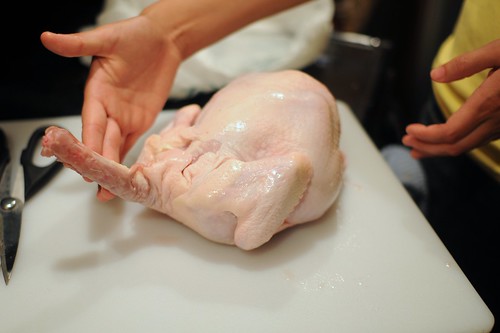
Meet George. He is our chicken. He is sassy and speaks with a French accent. He used to live in Mankato at Prairie Pride Farm where he spent his days in clover pastures, eating clover, alfalfa, oats, grasses, non-GMO corn, and bugs and being a chicken. Now, he is in my fridge, soon to become roasted, Zuni Cafe style.
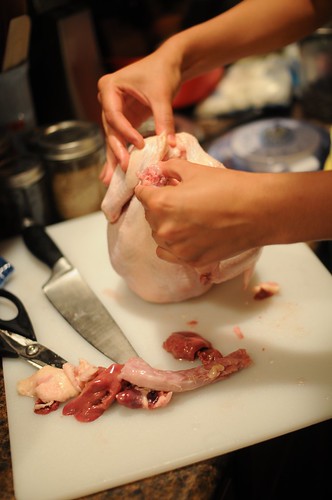
We removed his organs. We (well, Alex) chopped off his neck. Then we gave him a bath and patted him very, very dry.
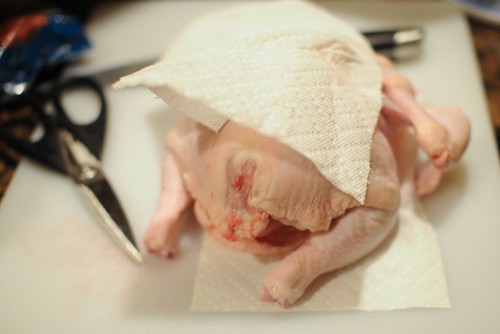
Then we stuck our fingers between his skin and breasts and gave him herbal implants of sage, marjoram, thyme, and rosemary.

We did the same to his thighs.
Then we rubbed him down with salt. Lots of salt. And some pepper. We even put some inside his cavity. Just a little. Not too much.
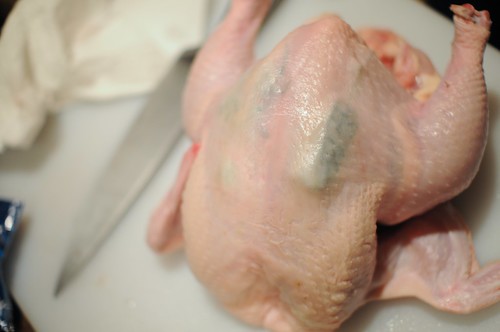
And now he sits in the fridge for two whole days before he is dinner.
How Alex and I spent our Saturday Night:
Meet George. He is our chicken. He is sassy and speaks with a French accent. He used to live in Mankato at Prairie Pride Farm where he spent his days in clover pastures, eating clover, alfalfa, oats, grasses, non-GMO corn, and bugs and being a chicken. Now, he is in my fridge, soon to become roasted, Zuni Cafe style.
We removed his organs. We (well, Alex) chopped off his neck. Then we gave him a bath and patted him very, very dry.
Then we stuck our fingers between his skin and breasts and gave him herbal implants of sage, marjoram, thyme, and rosemary.
We did the same to his thighs.
Then we rubbed him down with salt. Lots of salt. And some pepper. We even put some inside his cavity. Just a little. Not too much.
And now he sits in the fridge for two whole days before he is dinner.
Friday, July 2, 2010
Strawberry Banana Soft Serve
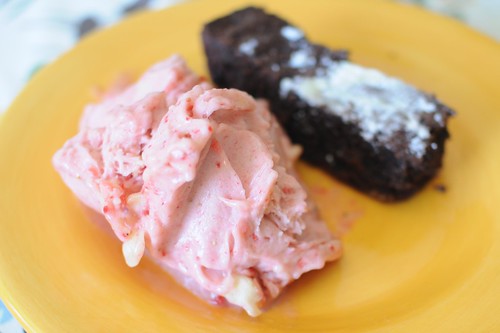
If you are into vegan or raw foods, or even if you're not and you just read a lot of food blogs, you may have come across this post about making raw vegan "ice cream" by simply sticking a frozen banana or two in the food processor. I tried it several weeks ago and it's true! It is the perfect substitution if you don't eat dairy. Don't get me wrong, I still love the real stuff, but this is a perfect healthy (and cheaper!) alternative for when it is so hot you want to eat ice cream every. single. day. And a great way give brown bananas a new life.
Since I started making this myself, both Ashley at (never home)maker and Ashley at The Edible Perspective have posted some variations, including adding things in like cherries, peanut butter, and cookies.
Today I was inspired to try something new. As I as putting my bag of frozen bananas back in the freezer, I saw my GIANT bag of frozen local strawberries I have been adding to as strawberry season comes to a close. I grabbed a small handful, threw them in, and voila: PINK soft serve. The perfect thing to cheer you up when you have unexpected, last minute wedding-planning chaos. Even more perfect if you eat it with a brownie!
Strawberry Banana Soft Serve
1.5 frozen bananas
About 1/4 cup frozen strawberries (I'm guessing fresh would work too)
Put ingredients in food processor until texture is ice cream like. Yup. That's it.
Makes 1 large serving.
Wednesday, June 23, 2010
Ginger-Molasses Cookies
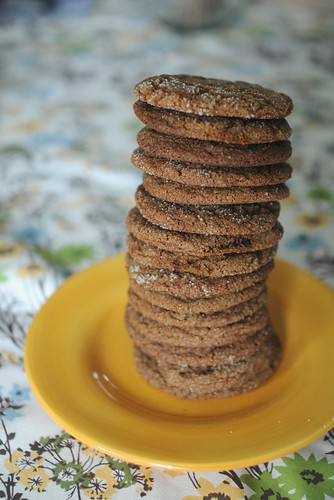
Exciting news: I OWN A STAND MIXER!
Yes, a little over a week ago, my aunt threw me a bridal shower in St. Paul. I had a great time with all my friends, ate delicious food, and received lots of handy things for our new kitchen. My grandparents were generous enough to give me a gorgeous chrome Kitchen Aid stand mixer. I pulled it out of its box as soon as I got home and placed it in its new home on my counter. And that is where it sat for eight whole days before I touched it again.
I have wanted a stand mixer for the longest time. There have been so many recipes where I stood there, beating things with a hand mixer, or worse, a wooden spoon, for what seemed like forever, all the time dreaming of the day when a stand mixer would do all that work for me. When it was finally in my possession, I wanted to break it in with something that is hard to make without one. Something like the brioche I made a few months ago, where I cursed under my breath while kneading butter into the dough and made my entire kitchen a mess. Only, I didn't feel like making brioche. I thought and thought and thought and nothing seemed like the perfect first recipe for the mixer. Until I finally I gave up and decided I needed to make something right away. It was wrong for the stand mixer to sit there untouched for so long. I tried to get my fiance to give me an idea. After several unhelpful suggestions (potato salad??!?!), he finally mentioned gingerbread cookies. I searched several of my favorite blogs and found this recipe from Orangette. I ran to the store to get what I needed and finally plugged the Kitchen Aid in and watched the magic.

Ginger-Molasses Cookies
From Orangette
NOTE: The batter needs to be refrigerated for at least 2 hours, so keep that in mind when planning!
2 ¼ cups whole wheat pastry flour (all-purpose is fine too)
1 ½ tsp baking soda
2 tsp cinnamon
1 ½ tsp ground cloves
1 tsp salt
½ cup vegetable shortening, at room temperature
6 Tbs unsalted butter, at room temperature
1 ½ cups light brown sugar
2 eggs
2 tsp peeled and grated ginger
1/3 cup molasses
½ cup unrefined cane sugar (or granulated sugar)
Combine the flour, baking soda, cinnamon, cloves, and salt in a bowl and set side.
In the bowl of a stand mixer (or a regular bowl and use a hand mixer), beat the butter and brown sugar until smooth. Add the eggs one at a time, beating until fully incorporated each time. Then add the ginger and molasses and mix well.
Mix the dry ingredients into the wet, adding about 1/3 of the dry ingredients each time. When it is all added, cover the bowl in plastic wrap in set in the fridge for at least two hours. Molly says it can be kept in the fridge for 4 days at this point. I left it there overnight.

Preheat the oven to 350 degrees. Put the cane sugar in a shallow pan (I used a cake pan). Roll the dough into balls about 2 inches in diameter, eight at a time. Roll each ball in the sugar, coating it completely. Keep the dough in the fridge when you are not using it, otherwise it will warm up and become sticky and hard to work with. Cover a baking sheet with parchment paper and bake for 15-17 minutes (Mine were perfectly done at 15). Eight at a time should fit on a sheet.
When done, pull the parchment paper off the sheet and onto the counter to let cool. Take the cookies off the paper when cool enough and reuse for the next batch. I ended up with around 28 cookies (Molly said 22).
Friday, June 11, 2010
The United States of Arugula
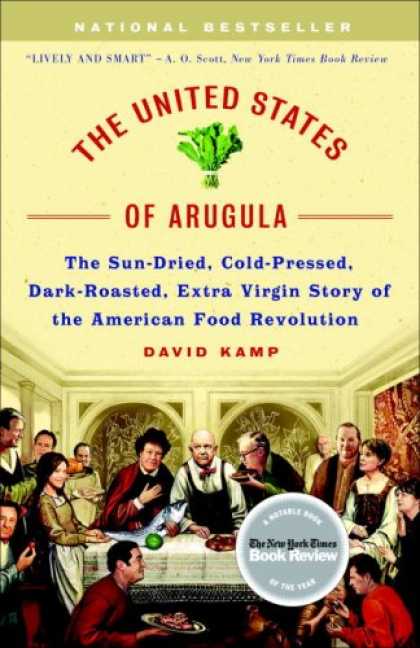
May's Foodie Book Club book was The United States of Arugula.
This book was a bit different than the previous selections in that it was more of a history book. The last two were very current and this book gets there eventually but starts at the roots of the foodie movement and goes all the way up to today, discussing Thomas Keller and Rachael Ray. I will admit I haven't finished it yet, but so far I've found it very fascinating. It traces the roots of 'foodie' culture back to the very beginning, discussing its founders such as James Beard and Julia Child. Maybe it is just that I am fairly new to the foodie scene, but I'd never thought much about where it came from, so reading about the very early history has been very interesting. It seems like a lot of pieces about foodie-ism seem nostalgic towards the "good old days" but I was surprised to find a lot of similarities between the public's ideas about food then and now. Even James Beard and the other first foodies were more outcasts than representatives of popular opinion.
Unfortunately, I don't have much more to say at the moment. It was a busy month with finals and wedding planning, but I do plan on finishing it as soon as I get a chance. Perhaps I will write up a better review then. I have this month's book already and am looking forward to reading it, so I promise to at least have a better review next time!
Thursday, June 10, 2010
Vegan Banana Coconut Oatmeal Pancakes
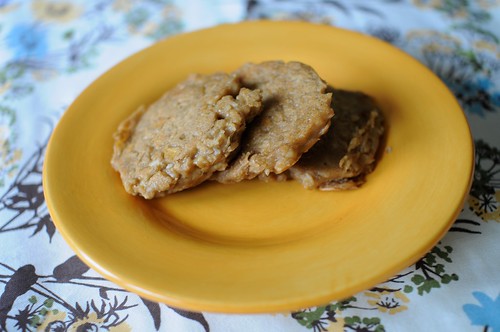
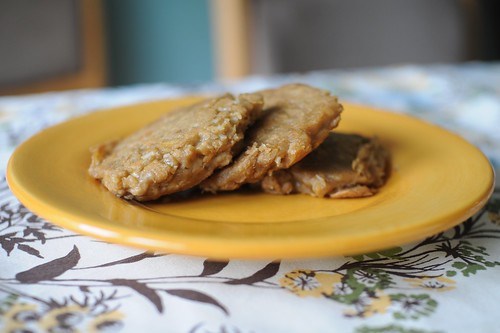
I'd been planning to make this recipe straight out of the book, but I was out of milk and lazy. I decided if I was going to use the soy or almond milk in my fridge, I might as well ditch the eggs too and veganize the whole thing. As I was waiting for the skillet to heat up, I spied my glass jar of unsweetened shredded coconut and decided to add some in at the last minute. These pancakes are a lot different than the light, fluffy type I usually go for. The oat flour and oatmeal make them especially dense and...well, oatmealy. Different, but delicious. I also highly recommend chocolate chips.
Vegan Banana Coconut Oatmeal Pancakes
Adapted from Good to the Grain
Dry:
3/4 cup oat flour
1 cup all-purpose flour (whole wheat pastry would work too)
2 tbsp sugar
2 tsp baking powder
3/4 tsp kosher salt
1 cup unsweetened shredded coconut
Wet:
2 tbsp canola oil
1 1/4 cups nondairy milk (I used soy)
1 cup cooked oatmeal
1 tbsp unsulphured molasses (not blackstrap)
1 banana, mashed
Chocolate chips (optional)
Sift the dry ingredients together and set aside. In a separate bowl, whisk together the oil, milk, oatmeal, molasses, and banana. Fold the wet ingredients into the dry ingredients and be careful not to overmix. If not using immediately, it can be kept in the fridge overnight, but may need to be thinned with milk.
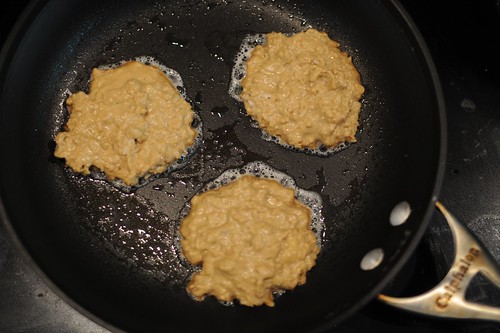
Heat a skillet over medium heat. When hot, scoop the batter (about 1/4 cup at a time) and cook until bubbles form and then flip.
Subscribe to:
Posts (Atom)